The Founder Is the Brand, Whether They Accept It or Not
4 minutes
Introduction
There is a quiet decision most founders make without realizing they've made it.
They decide to let the company speak for itself. They put the logo on the website, hire someone to run the social channels, and stay personally invisible. The brand will speak. The work will speak. There is no need for the founder to step forward.
It's an understandable instinct. And in almost every case, it is a strategic mistake.
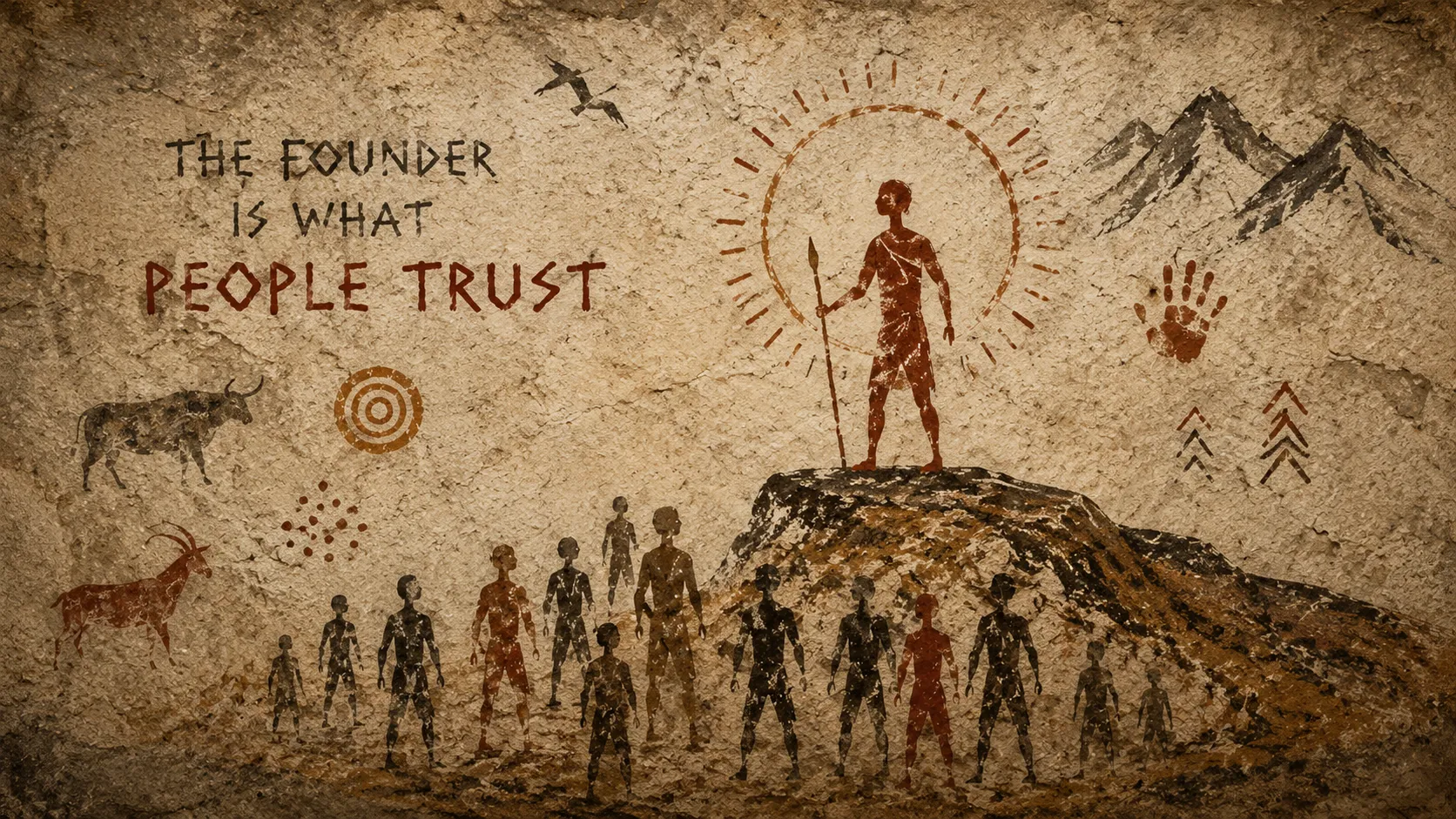
No matter how good the product is or how polished the website becomes: in an early-stage company, the market does not form its perception of the business through just the company. It forms it through the founder. The founder is the first signal, the first source of trust, and the first reason someone leans in. The founder is the brand, whether they accept that role or not.
The important question is whether the founder is shaping that perception deliberately, or letting it form by default.
The World Has Quietly Changed
There was a time when companies could hide behind their corporate identity. The logo did the work. The press release did the work. Customers and investors made decisions based on the entity, not the individual behind it.
That time is over.
Today, people trust people. They have always trusted people more than institutions, but the internet has stripped away the layers that used to obscure that fact. Buyers research the founder before they research the company. Investors look at your LinkedIn before they open the deck. Talent decides whether to apply based on what the CEO sounds like in interviews. Customers want to know who is behind the thing they're paying for.
This is the same instinct that made celebrity endorsements work for decades. It is the reason the influencer economy exists. It is the reason a company will pay millions for a recognizable face to attach to a product. The underlying truth is simple: a human face creates trust faster, deeper, and at lower cost than any corporate identity ever will. Founders are the original version of this. And unlike a paid endorsement, a founder's presence is free, native, and credible by default.
The Founder Is the Cheapest, Most Effective Marketing Channel a Company Has
Look at Elon Musk. Whatever one thinks of him personally, the strategic reality is undeniable. Tesla famously spends near-zero on traditional advertising. The company doesn't need to. Musk's personal presence, his posts, his statements, his public persona does the work that would otherwise cost hundreds of millions in paid media every year. His personal channel is the single most effective marketing vehicle his companies have. That is not an accident. It is a strategy.
Look at Richard Branson. The Virgin Group spans businesses that have almost nothing in common operationally, like airlines, telecoms, music and space. What holds them together as a brand is Branson himself. His adventurous, irreverent, and customer-obsessed personality has become the connective tissue of every Virgin company. The brand attracts a specific kind of customer and a specific kind of employee because the founder embodies a specific kind of energy. Strip Branson out, and the Virgin brand is significantly harder to define.
These are not stories about charisma. They are stories about leverage.
A founder who is personally present in their market is generating compounding trust with every appearance, every post and every conversation. That trust is being deposited directly into the brand's account. There is no other marketing channel that works this way. No campaign, no ad spend, or PR retainer can replicate what a credible, recognizable founder produces for free.
What People Are Actually Buying When They Buy from a Startup
When a customer chooses an unknown brand over a known one, they are not just buying the product. They are buying the founder's judgment. They are betting that the person behind the company has the taste, discipline, values, and the seriousness to deliver something worth their money. They cannot evaluate the product fully yet because it's too early and the data is too thin, so they evaluate the founder.
The same is true of investors. The same is true of senior hires. The same is true of partners. Every early-stage decision made about the company is, in practice, a decision made about the founder.
This is why a founder's personal clarity and their ability to articulate what they're building has such an outsized effect on company outcomes. It isn't just communication. It is the primary medium through which the company is being underwritten by everyone who matters. A founder with sharp personal clarity makes the company easy to trust and a founder without it makes the company a guess.
The Founder's Brand Decides Who the Company Attracts
There is a less obvious consequence of founder presence that almost no one talks about: the founder's personal brand determines the kind of people who get attracted to the company.
The customers a brand attracts mirror the founder. The talent the company attracts mirrors the founder. The investors who reach out mirror the founder. The partners who want to collaborate mirror the founder.
This is true whether the founder is intentional about it or not. The signal goes out, and the market sorts itself accordingly.
A founder who communicates with rigor attracts rigorous clients and serious operators. A founder who communicates with chaos attracts chaotic opportunities and short-term thinking. A founder who is invisible attracts whoever happens to find them.
The composition of a company, in its earliest years, is essentially a portrait of its founder's public presence. If a founder doesn't like the type of customers or talent showing up at the door, the answer is rarely a new marketing campaign. It is almost always a sharpening of the founder's own signal.
Why So Many Founders Resist This
Some are introverts and find public presence draining. Some have come from corporate cultures where the institution does the talking and the individual stays quiet. Some are worried about ego and that putting themselves forward will be read as self-promotion. Some are simply uncomfortable being visible. These are real concerns, and they deserve respect. But none of them change the underlying mechanics.
The market is going to form an impression of the founder either way. The only choice is whether that impression is shaped, or left to chance.
Personal branding for a founder is not about becoming a content creator. It is not about posting daily, performing personality, or chasing visibility for its own sake. It is about clearly articulating what you believe, what you build, who you build it for, and why. That clarity, expressed consistently in the channels where your market actually pays attention, is what compounds into trust.
Authority Before Visibility
Visibility without authority is forgettable at best, embarrassing at worst. A founder who is loud but unclear becomes background noise. A founder who is loud and contradicts what their company stands for actively damages the brand.
Authority comes first. Authority means having something specific to say, a clear point of view about the market, the customer, the problem, and the solution. It means saying it with the conviction of someone who has earned the right to say it, because they actually do the work. Once authority is built, visibility amplifies it. The founder becomes someone whose perspective is worth following, hiring, buying from, or backing.
This is the difference between a founder who is famous in their market and a founder who is merely active on a platform. The first is an asset. The second is a habit.
What This Means in Practice
If you are a founder, the question is not whether to have a personal brand. You already have one. The question is whether that brand is intentional.
You do not have to become Elon Musk or Richard Branson. You do not have to post daily, build an audience, or perform a public personality. But you do have to be clear about what you believe, what you are building, what you stand for, and what you are unwilling to compromise on. You have to be findable. You have to be readable. You have to be recognizable to the people whose decisions matter to your company.
The only decision is whether the founder is going to shape that brand on purpose, or let it shape itself by default.
Both are choices. Only one of them compounds.